From the hiss of steam in early locomotives to the silent precision of a semiconductor fab, the pressure gauge has been an indispensable sentinel of industry. Its journey, beginning as a simple mechanical observer, is now evolving into a sophisticated, intelligent node in the hyper-connected world of the Industrial Internet of Things (IIoT).
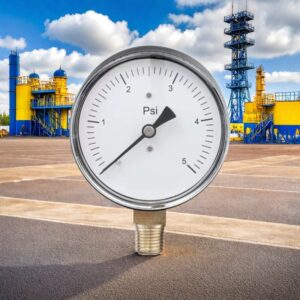
The story of the pressure gauge is fundamentally the story of the Industrial Revolution. Before its invention, our understanding of pressure was vague and dangerous. The first practical device is credited to German engineer Otto von Guericke in the 17th century with his vacuum pump, but the true breakthrough came in 1849 with Eugène Bourdon’s patent for the Bourdon tube. This elegantly simple invention—a curved tube that straightens under internal pressure—provided a reliable, accurate, and safe method for measuring pressure. It quickly became the global standard, forming the heart of mechanical gauges for over a century. These analog devices, with their familiar dial and pointer, became the eyes of factory workers, ensuring the safe operation of boilers, pipelines, and hydraulic systems. Their legacy is one of democratized safety, transforming a volatile unknown into a quantifiable, manageable variable.
The latter half of the 20th century ushered in the age of electronics, marking the first major evolution in pressure measurement. Strain gauge and piezoelectric sensors began to replace mechanical linkages, converting physical pressure into an electrical signal. This shift from analog to digital offered unprecedented advantages: higher accuracy, remote readability, and seamless integration with Programmable Logic Controllers (PLCs). The pressure gauge was no longer just a local indicator; it became a data point in automated control systems, enabling complex industrial processes to run with minimal human intervention.
As we look to the future, the pressure gauge is undergoing its most profound transformation yet. The current frontier is not just digital, but intelligent. The modern pressure sensor is evolving into a complete diagnostic hub. These “smart” gauges are equipped with microprocessors, self-diagnostic capabilities, and wireless communication protocols like Bluetooth, LoRaWAN, and 5G. They can detect drift, predict calibration needs, and trigger automated shutdowns before a failure occurs—moving from passive measurement to active predictive maintenance.
Furthermore, the future is decentralized. While the Bourdon tube was a symbol of centralized, heavy industry, the smart pressure sensor is enabling the distributed infrastructure of tomorrow. It is a critical component in the optimization of smart water grids, hydrogen fuel cell systems, and the monitoring of pharmaceutical cold chains. These sensors will not simply report data; they will communicate with cloud-based AI platforms that analyze historical trends to predict equipment lifespan, optimize energy consumption, and prevent environmental leaks with a precision unimaginable to 19th-century engineers.
In conclusion, the pressure gauge has journeyed from a simple mechanical safeguard of the steam age to a sophisticated data node in the digital era. Its history is a testament to the human need to control and understand hidden forces. As industries pivot toward autonomy, sustainability, and artificial intelligence, the humble pressure gauge will remain at the heart of it all—not as a passive observer, but as an intelligent, communicating cornerstone of the next industrial revolution.